Tag: Zero-Trust Issues

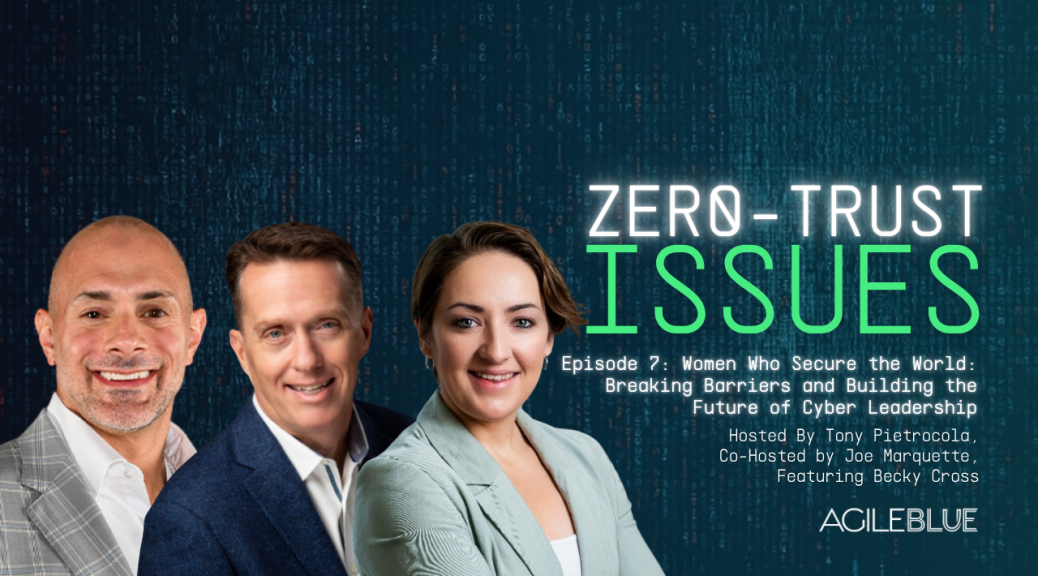
Women Who Secure the World: Breaking Barriers and Building the Future of Cyber Leadership (Ep. 7)

Women Who Secure the World: Breaking Barriers and Building the Future of Cyber Leadership (Ep. 7)

Most cybersecurity conversations focus on tools and threats. The better ones focus on people, trust, and how leaders actually show up when things go sideways.

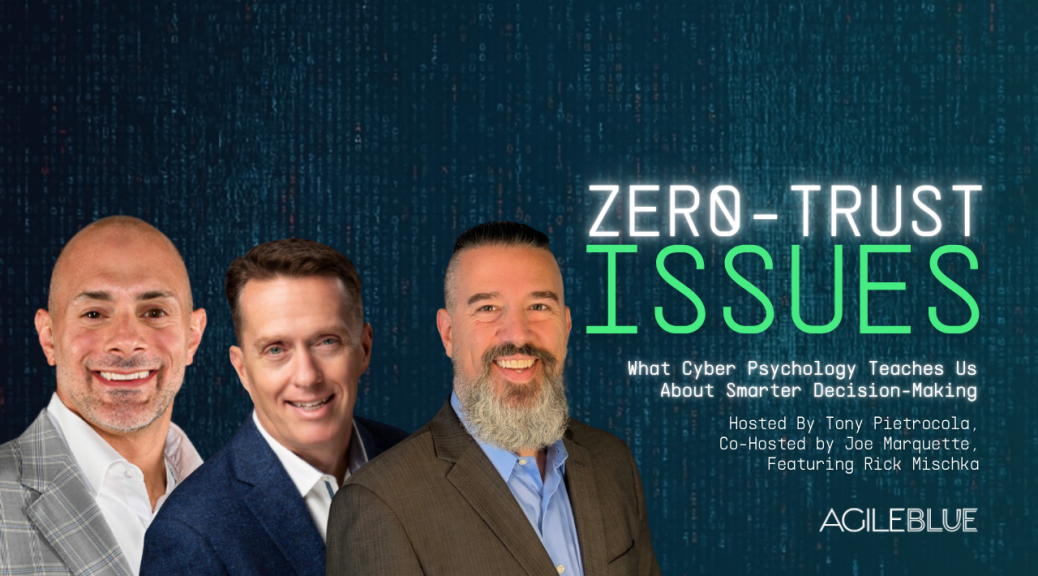
In this episode, Tony Pietrocola, President and Co-founder of AgileBlue, and Joe Marquette, CEO and Co-founder, sit down with Becky Cross, Vice President of Client Partnerships at FIT Technologies.

They get into how cybersecurity leadership is shifting, what clients actually need in high-pressure moments, and why the way we communicate risk matters just as much as the technology behind it.

Becky brings a perspective that’s grounded in real client experience. Less noise, more clarity. Less fear, more trust. And a clear argument for why different perspectives lead to better decisions when it matters most.

Key takeaways:

  • What it looks like to lead with clarity when clients are under pressure
  • How asking better questions changes the outcome of client relationships
  • Where confidence and perception can get misaligned in leadership roles
  • Why diverse teams tend to make stronger, more balanced decisions
  • How representation continues to shape the future of cybersecurity
  • And more!

Connect with Tony Pietrocola:

Connect with Becky Cross:

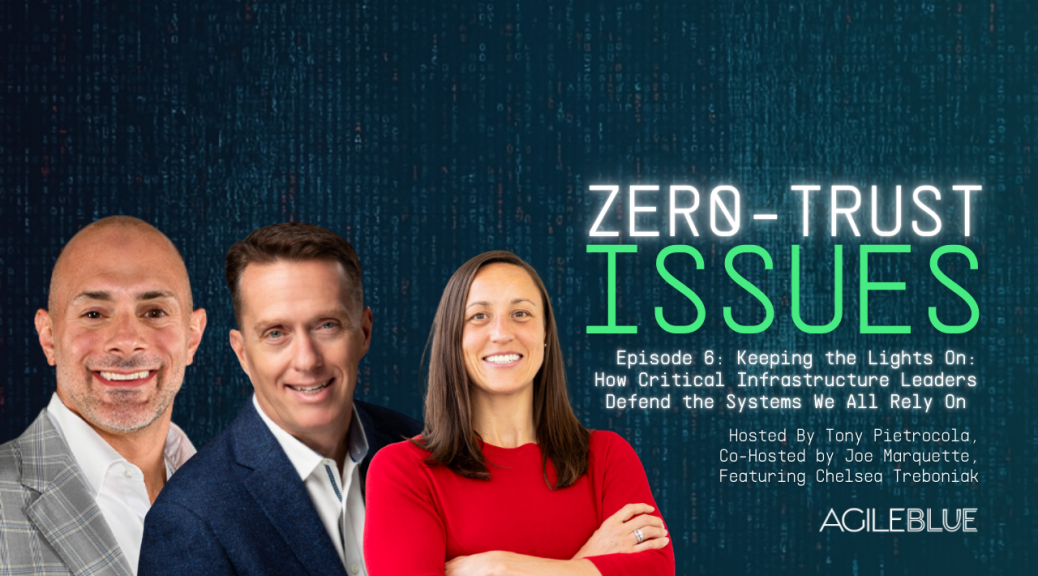
Keeping the Lights On: How Critical Infrastructure Leaders Defend the Systems We All Rely On (Ep. 6)

Keeping the Lights On: How Critical Infrastructure Leaders Defend the Systems We All Rely On (Ep. 6)

What happens when the systems we rely on every day stop working? A former Army officer shares how real-world failures reveal the hidden connections inside critical infrastructure.

In this episode, host Tony Pietrocola, President and Co-founder of AgileBlue, and co-host Joe Marquette, AgileBlue CEO and Co-founder, sit down with Chelsea Treboniak, U.S. Army veteran, West Point graduate, and owner of Critical Ops. Drawing from her experience deploying with the 82nd Airborne Division and working across critical infrastructure sectors, Chelsea explains why financial systems, energy, identity access, and supply chains are deeply interconnected.

The conversation explores why modern cybersecurity challenges go far beyond traditional IT environments. Chelsea shares how disruptions in one system can ripple across entire sectors, why disaster recovery plans often fail when they are not tested, and how leaders must rethink risk in a world of tightly coupled digital and physical systems. The discussion also tackles the growing role of automation and AI in security operations. While these tools can improve efficiency, Chelsea emphasizes that human judgment, accountability, and leadership remain essential when systems face unexpected failures.

Key takeaways:

  • Critical infrastructure failures rarely happen in isolation; disruptions in one system often cascade across others.
  • Financial services play a larger role in infrastructure resilience than many leaders realize.
  • Business continuity and disaster recovery plans only work when they are tested under real conditions.
  • Automation and AI can improve efficiency, but human decision-making remains essential in high-pressure situations.
  • Leaders must embrace humility and curiosity to identify hidden risks across interconnected systems.
  • And more!

Connect with Tony Pietrocola:

Connect with Joe Marquette:

Connect with Chelsea Treboniak:

AI Beyond the SOC: Preparing People and Businesses for a Long-Term Shift (Ep. 5)

AI Beyond the SOC: Preparing People and Businesses for a Long-Term Shift (Ep. 5)

AI can detect disease from your voice.

It can write code, replace junior roles, and potentially reshape global power structures.

So the real question is not whether AI is advancing. It’s whether we can control what we don’t fully understand.

In this episode, host Tony Pietrocola, President and Co-founder of AgileBlue, and co-host Joe Marquette, AgileBlue CEO and Co-founder, sit down with AI strategist, advisor, and educator Jason Lowe to explore how rapidly expanding AI capability is outpacing control mechanisms across industries. From healthcare breakthroughs to workforce disruption and global AI competition, the conversation moves beyond hype into practical leadership realities.

Key takeaways:

  • AI is expanding faster than governance and control frameworks can keep up.
  • Continuous learning models could fundamentally change how AI systems behave and evolve.
  • The global AI race is not just commercial; it carries geopolitical implications.
  • AI-driven productivity gains are reshaping entry-level and junior workforce roles.
  • The five human skills that will matter most in an AI-driven world: collaboration, communication, curiosity, creativity, and critical thinking.
  • And more!

Connect with Tony Pietrocola:

Connect with Jason Lowe:

AI Sidekicks: How Artificial Intelligence is Changing Security Ops (Ep. 4)

AI Sidekicks: How Artificial Intelligence is Changing Security Ops (Ep. 4)

AI is moving faster than most organizations are ready for, and the real risk is not the technology itself, but how leaders choose to adopt it. From boardrooms to security operations centers, the balance between innovation and control has never mattered more.

In this episode, host Tony Pietrocola, President and Co-founder of AgileBlue, and co-host Joe Marquette, AgileBlue CEO and Co-founder, are joined by Ken Stasiak, veteran cybersecurity leader and founder of NegotiatorIQ, to unpack what AI adoption really means for security teams, executives, and boards. Together, they explore how AI mirrors the early days of the internet boom, why cultural readiness matters just as much as technical capability, and how organizations can avoid overtrusting or underutilizing AI. Ken shares insights on governance, cognitive bias, SOC transformation, and the human responsibility that must remain firmly in place as automation accelerates.

Key takeaways:

  • Why AI adoption today feels similar to the internet boom of the late 1990s
  • The difference between AI as a tool and AI as a decision-maker
  • How overtrusting AI can create long-term regulatory and operational risk
  • Why culture and leadership mindset determine successful AI integration
  • What a healthy human + AI workflow looks like inside a modern SOC
  • And more!

Connect with Tony Pietrocola:

Connect with Ken Stasiak:

Lost in Translation: Turning Cyber Risk Into Executive Action (Ep. 3)

Lost in Translation: Turning Cyber Risk Into Executive Action (Ep. 3)

Cybersecurity doesn’t fail because of weak tools. It fails because of weak translation.

When executives hear acronyms instead of impact, critical decisions stall.

In this episode of Zero Trust Issues, host Tony Pietrocola, President and Co-founder of AgileBlue, and co-host Joe Marquette, AgileBlue CEO and Co-founder, sit down with seasoned CISO Lee Buttke to unpack one of the most overlooked risks in modern cybersecurity: the communication gap between technical teams and business leadership.

Drawing from real-world incident experience, Lee shares how overly technical reporting during a breach created confusion at the executive level, and what security leaders should focus on instead.

Key Takeaways:

  • Why cyber acronyms like TTPs can derail executive understanding
  • The difference between technical reporting and business impact reporting
  • How to communicate containment, exposure, and operational disruption clearly
  • Why cybersecurity maturity frameworks create alignment across leadership
  • How assigning a monetary value to cyber risk drives smarter decisions
  • The role of the CISO in elevating cybersecurity conversations to the board level
  • Why resilience in 2026 depends on proactive communication, not reactive defense
  • And more!

Connect with Tony Pietrocola:

Connect with Lee Buttke:

Cyber Risk 2026: What Every Business Leader Should Be Paying Attention To (Ep. 2)

Cyber Risk 2026: What Every Business Leader Should Be Paying Attention To (Ep. 2)

When the lights stay on, most people assume everything is fine. But what if the real danger is unfolding quietly behind the scenes?

In this episode, host Tony Pietrocola, President and Co-founder of AgileBlue, sits down with AgileBlue CEO and Co-founder Joe Marquette and Major General (Ret.) Ryan Heritage, former Director of Operations at U.S. Cyber Command. They unpack the evolving risks facing critical infrastructure and why modern cyber threats are more subtle, persistent, and strategic than ever.

Key takeaways:

  • Why critical infrastructure now extends far beyond traditional military targets
  • How the cyber domain functions as both maneuver space and a weapons platform
  • What “persistent engagement” means in today’s peer-to-peer cyber competition
  • Why AI currently provides asymmetric advantages to attackers
  • The importance of constantly challenging security assumptions at the executive level
  • And more!

Connect with Tony Pietrocola:

Connect with Joe Marquette:

Connect with Ryan Heritage:

Who the Hack Is AgileBlue? (Ep. 1)

Who the Hack Is AgileBlue? (Ep. 1)

A deal fell apart at the worst possible moment, and instead of ending the story, it sparked the idea that became AgileBlue. In Episode 1 of Zero-Trust Issues, the founders share how a setback at Black Hat helped shape their approach to cybersecurity, automation, and resilience.

In this first episode of Zero-Trust Issues, host Tony Pietrocola, President and Co-founder of AgileBlue, sits down with co-host Joe Marquette, AgileBlue CEO and Co-founder, and Chief Technology Officer Stephen Smith to tell the company’s origin story and what it revealed about the cybersecurity market. The conversation begins in August 2019 at Black Hat in Las Vegas, when the team learned they’d lost what they believed would be their first major deal—sparking an immediate “are we done?” moment. From there, they unpack what it takes to build a security business that can scale without simply adding more headcount. They also discuss why visibility matters when communicating cyber risk to executives and boards, and why “AI-native” security is quickly becoming table stakes as attackers adopt the same tools.

Key takeaways:

  • How resilience after a setback can become a competitive advantage
  • Why scaling security operations requires automation—not just more people
  • What “AI vs. AI” means in practice, and why AI-native defense is no longer optional
  • How to make cyber risk visible and understandable for CEOs and boards
  • The real-world pain points in legacy security models that led AgileBlue to build differently
  • And more!

Connect with Tony Pietrocola:

Connect with Joe Marquette:

Connect with Stephen Smith: